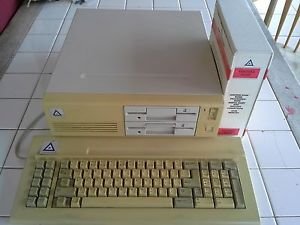
Appearance: Used,shows some aging.Functionality: MostlyWorkingDescription:============As pictured, a LeadingEdge Model D computer, model # DC-2011. Configured as follows:- Dual 5.25” 360kfloppy drives- 256k RAM(Expandable on-board to 640k)- On-board video: Mono/CGAswitchable- 4x free 8-bit ISAslots- Original keyboard- Full set ofmanuals and disks (see pictures)It is exactly theway it was received from the factory, but please note:- The keyboard cableis aging, although still intact and working.- The second floppydrive behaves as expected but is unable to read disks.- The port labelsticker is getting loose.- DOS diskette is acopy, not original.- The original disksare aging and difficult to read.- Battery leaked andwas removed – area cleaned as well as possible (see picture)- The system is not100% stable. Encounters intermittent POST/Boot difficulties and errorsexperienced after 15-30min of use.Monitor and upgradesare available, please ask.Warranty andReturns:=====================We understand thatthere may be compatibility issues, space constraints, or it just doesn’t lookperfect. This item can be returned within 14-days for ANY reason. However,shipping to and from is not refundable. Shipping:=========- Local pickup isalso available at no cost.- Most orders placedbefore 9am will ship the same day.Stock#:1627The Leading EdgeModel D was an IBM clone computer first released by Leading Edge Hardware inJuly 1985. It was initially priced at $1,495 configured with dual 5.25"floppy drives, 256 KB of RAM, and a monochrome monitor. It was manufactured bySouth Korean conglomerate Daewoo and distributed by Canton, Massachusetts-basedLeading Edge.[1] Engineer Stephen Kahng spent about four months designing theModel D[2] at a cost of $200,000.[3] Kahng later became CEO of Macintosh clonemaker Power Computing.In August 1986,Leading Edge cut the price of the base model by $200, to $1,295, and increasedthe base memory of the machine to 512 KB.[4]The Model D was animmediate success, selling 100,000 units in its first year of production. Itcontinued to sell well for several years, until a dispute with its dealersforced Leading Edge into bankruptcy in 1989.[5]HardwareThe Model Dinitially featured an Intel 8088 microprocessor at 4.77 MHz, although latermodels had a switch in the back to run at 4.77 MHz (normal) or 7.16 MHz (high).Earlier models had no turbo switch and ran only at 4.77 MHz, while a few of thelater ones (seemingly very rare) were 7.16 MHz only. Three models are known:DC-2011, DC-2010E, and DC-2011E. The "E" seems to correlate with thecapability of running at 7.16 MHz.Unlike the IBM PCand IBM PC/XT, the Model D integrated video, the disk controller, a batterybacked clock, serial and parallel ports directly onto the motherboard ratherthan putting them on plug-in cards. This allowed the Model D to be half thesize of IBM's models.[5]The motherboard camein eight different revisions: Revision 1, 5, 7, 8, CC1, CC2, WC1, and WC2. Alist of motherboard part numbers and revision numbers can be found here.Revisions 1 through 7 were usually found in model DC-2011, with revisions 8through WC2 being either in 2010E or 2011E. WC1 (presumably also WC2) is 7.16MHz only. Due to its tight integration, the Model D motherboard was anonstandard form factor, so replacing the motherboard with an off-the-shelfupgrade was not possible.They camepreinstalled with 256, 512, or 640 KB of RAM. Lower-capacity machines were userupgradeable to 640 KB.[6] Motherboard revisions 7, 8, WC1 and WC2 came with 768KB of RAM installed (640 KB available to the user).Some models featureda monochrome/CGA selection switch, with a single port used for both modes. Somemodels had both a Monochrome and a CGA port, also with a switch to change modes(and ports).[6]The Model Dcomputers supported a special extended graphics mode: 640x200.Leading Edge Model D(fixed-disk model)The buyer had thechoice between a floppy disk model and a fixed disk (hard disk) model. Thefloppy disk model had one or two 360 KB drives, so that the user could runMS-DOS programs on the primary drive and work with files on the secondarydrive, if equipped.[6] The fixed disk model had one 360 KiB floppy drive andeither a 10 MB, 20 MB, or 30 MB hard disk. The model with the 20 MB fixed diskwas initially released in February 1986 at a cost of $1,895.[7] Leading Edgedealers had difficulty keeping the 20MB model in stock.[7] At the time, a Tandy1200 equipped with a 10MB drive sold for $1999.The buyer also had achoice between an amber or a green monochrome CRT monitor.SoftwareThe unit came withMS-DOS 2.11 or later,[1] and a special edition of GW-BASIC to support theextended graphics mode.It also came with adiagnostics disk. This disk contained a diagnostics program, and PARK.COM, autility used to park the hard drive heads when the computer was to be moved.Most models also came with a word processing program developed by Leading Edgetitled Leading Edge Word Processor, commonly referred to by its acronym 'LEWP'.The computersupports the Microsoft Windows operating system up to version 3.0, as it is thelast version of Windows to support Real Mode.SignificanceDataquest estimatedthat the Model D won 1% of the American home-computer market in 1986, its firstyear of availability.[8] Its $1,495 list price was the lowest of sevencompatibles with comparable configurations in a September 1985 InfoWorld chart,and almost half the price of the $2,820 IBM PC.[9] Along with the Tandy 1000and Epson Equity series, the Model D was one of the first IBM PC compatiblecomputers to become popular for home use, due to its low price and goodreviews. Previously, MS-DOS and IBM Compatibles were almost exclusively used inbusinesses, with the home computer market dominated by Commodore, Apple andAtari. For years afterward, many home-oriented software packages for the PCspecifically cited the Model D along with the Tandy and Epson models ascompatible hardware.Leading Edge wasPhoenix Technologies' first customer for its IBM-compatible BIOS, and the ModelD was one of the first PCs on the market to use the Phoenix BIOS.[10] Althoughadvertised as 100% IBM compatible, numerous letters published in the January13, 1986 issue of InfoWorld identified compatibility issues with severalpopular software packages and aftermarket hard drives. Syndicated newspapercolumnists T.R. Reid and Michael Schrage, writing in April 1986, predicted thatthe popularity of the Model D would lead to hardware and software vendorsspecifically testing for compatibility. In spite of these early reports, theModel D continued to sell well. In early 1987, Daewoo was producing 13,000units per month and failing to keep up with demand. As a result, buyers waited2–8 weeks before taking delivery.[11]The Model D also hasthe distinction of being the first Korean-made PC to be sold in the UnitedStates, and at the time of its introduction, it undercut the price of similarIBM PC compatibles by $500.[12]ReceptionPC Magazine inOctober 1985 called the Model D "the clear winner" among six inexpensivePC compatibles it tested. The review noted the computer's many includedhardware features, and concluded that it "may represent the nextgeneration of personal computing: about as compact as full IBM hardwarecompatibility allows, full featured, quite well made, and alluringlypriced".[13] The Model D received 4 out of 5 stars from InfoWorld, whichpraised the computer's value and high level of compatibility, in December 1985;it concluded "We recommend it highly, especially to the budget-conscious beginner".[14]A positive October 1986 review in Popular Mechanics cited its low price and thequality of its keyboard.[15] It received good reviews in other computermagazines and Consumer Reports magazine.[5]